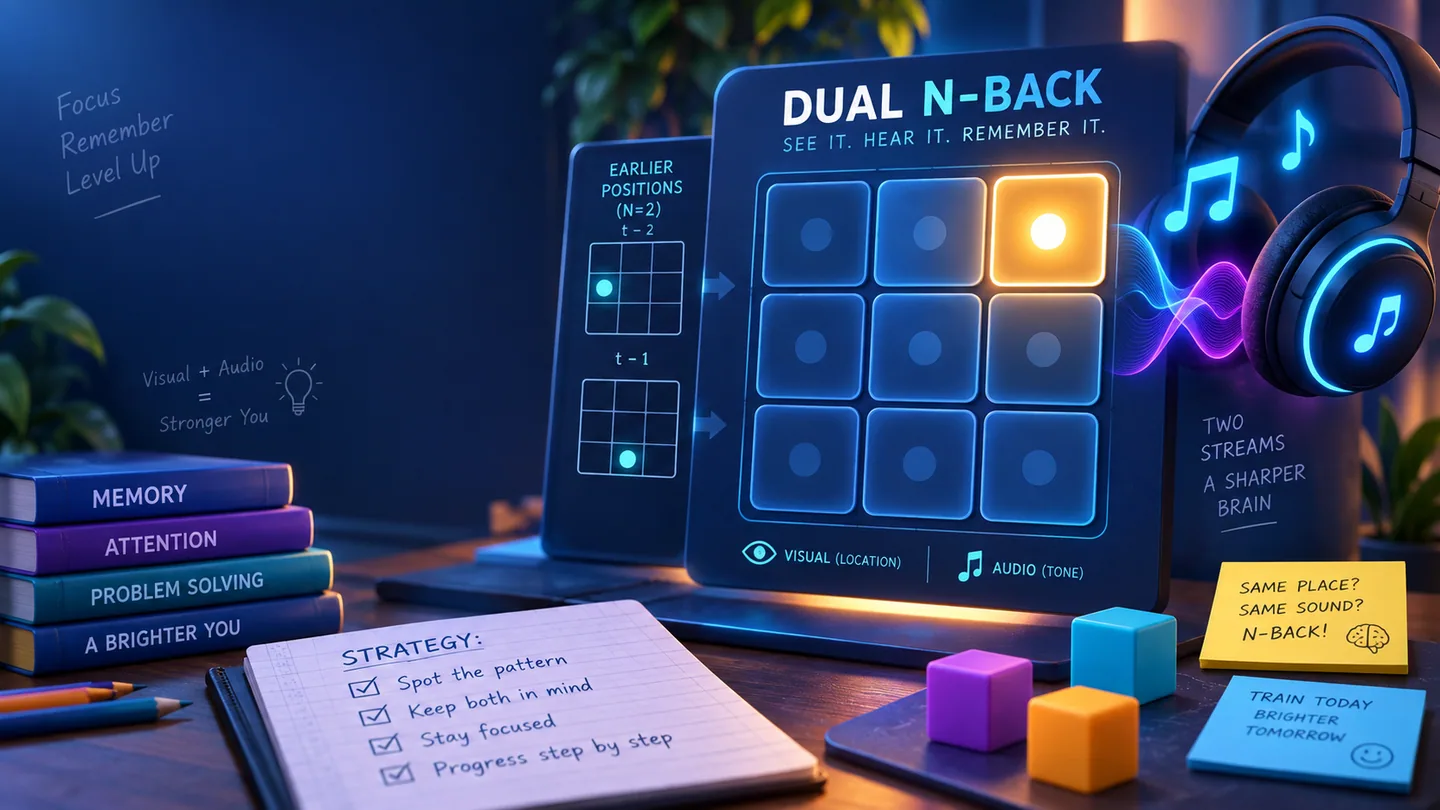
Dual N-Back Training Guide: Position and Audio Working Memory
Dual N-Back presents simultaneous position and sound sequences and asks whether each current stimulus matches the item exactly N steps earlier. The task trains continuous working-memory updating, not memorization of one long list. Accuracy and rhythm matter more than forcing a high N level.
Understand the rules first
Every trial contains a position and a sound. Press Position when the location matches N steps back and Audio when the sound matches N steps back. A trial may match both channels or neither. The comparison is strictly N steps earlier, not the most recent similar item.
Controls and observation
Respond after the stimulus and before the next trial. The two match buttons are independent, so press both on a double match. Avoid clicking repeatedly when uncertain; false alarms and misses both reduce accuracy.
Strategy by difficulty
Beginner
Begin with 1-Back or 2-Back and focus on applying the rule correctly. Imagine two separate queues, one for positions and one for sounds. Add each new item and discard anything older than the active window.
Intermediate
Do not bind position and sound into a single object. A repeated location does not imply a repeated sound. Keep the eyes near the center and use peripheral vision for position while assigning short mental labels to sounds.
Challenge and mastery
At higher N values, maintain only a rolling window of N+1 trials rather than recalling the whole session. Recover immediately after an error; reviewing it during later trials creates a cascade of misses. The goal is stable updating, not a perfect round.
A reliable solving routine
-
Confirm the active N value.
-
Add position and sound to separate rolling sequences.
-
Compare each channel independently with its item N steps earlier.
-
Respond promptly and move attention to the next stimulus.
Common mistakes
- Comparing with the most recent repeat instead of exactly N steps back.
- Pressing only one button during a double match.
- Dwelling on one mistake and missing several following trials.
Practice advice
Train for about 10–20 focused minutes at a time. Raise N only after several sessions of stable accuracy; lowering the level is more productive than practicing mostly guesses. Performance varies with sleep and fatigue and should not be treated as an intelligence diagnosis.
Quick answer
Dual N-Back presents simultaneous position and sound sequences and asks whether each current stimulus matches the item exactly N steps earlier. The task trains continuous working-memory updating, not memorization of one long list. Accuracy and rhythm matter more than forcing a high N level. Use this as the main decision rule: before every action, say what constraint it satisfies and what future option it preserves.
A worked attempt: think before acting
A useful first-pass approach is: begin with 1-Back or 2-Back and focus on applying the rule correctly. Imagine two separate queues, one for positions and one for sounds. Add each new item and discard anything older than the active window. After that move, pause and compare the actual state with the one you predicted. If they differ, correct the model before adding more actions.
Now test the opposite of a common failure: comparing with the most recent repeat instead of exactly n steps back. Instead of repeating that pattern, undo to the first decision that created it and choose the move that leaves more legal continuations. This turns an apparent mistake into a reusable solving example.
How the difficulty curve changes
Early levels isolate one rule so the result of each move is easy to see. Intermediate levels combine two rules and make move order important. Challenge levels add look-alike states, tighter space, or longer dependencies. Mastery means explaining why a move is safe, not merely remembering a solution.
For a new level, use three passes:
-
Map: identify fixed goals, movable parts, forbidden states, and scarce spaces.
-
Plan: choose one short milestone that can be checked immediately.
-
Verify: after reaching it, confirm that the next milestone remains possible.
Frequently asked questions
What should I focus on first in Dual N-Back Training?
Start with the most restrictive rule described at the top of this guide. Forced moves, narrow corridors, limited capacity, or unique candidates reduce the search space fastest.
What is the most common reason a valid move becomes a bad move?
A move can be legal now but destroy a future option. The warning sign in this puzzle is: comparing with the most recent repeat instead of exactly N steps back. Check the state one or two actions ahead before committing.
How do I know whether I am improving?
Track one measure at a time: fewer restarts, fewer undos, lower move count, better accuracy, or the ability to explain each choice. A faster time is meaningful only when correctness stays stable.
Are the daily and shared challenges different from ordinary levels?
They use the same game rules. The daily challenge provides a date-based common puzzle, while a challenge link preserves a specific level or state so two players can compare decisions on equal terms.
Key terms
- State: all information needed to determine the next legal actions.
- Constraint: a rule that eliminates impossible choices.
- Look-ahead: predicting the result of one or more actions before making them.
- Dead end: a legal-looking state from which the goal can no longer be reached.
- Efficiency: useful progress per move rather than motion for its own sake.
A deliberate practice routine
Play once without worrying about score. On the second attempt, stop at the first uncertainty and state two candidate actions. Predict the consequence of each, choose one, and use undo only to test the prediction. On the third attempt, aim to remove one unnecessary reversal or guess.
Use the daily challenge for transfer: it prevents you from memorising only a fixed level sequence. Use shared challenges for explanation: send the exact puzzle, compare the first point where your routes differ, and discuss which future option each move preserved.